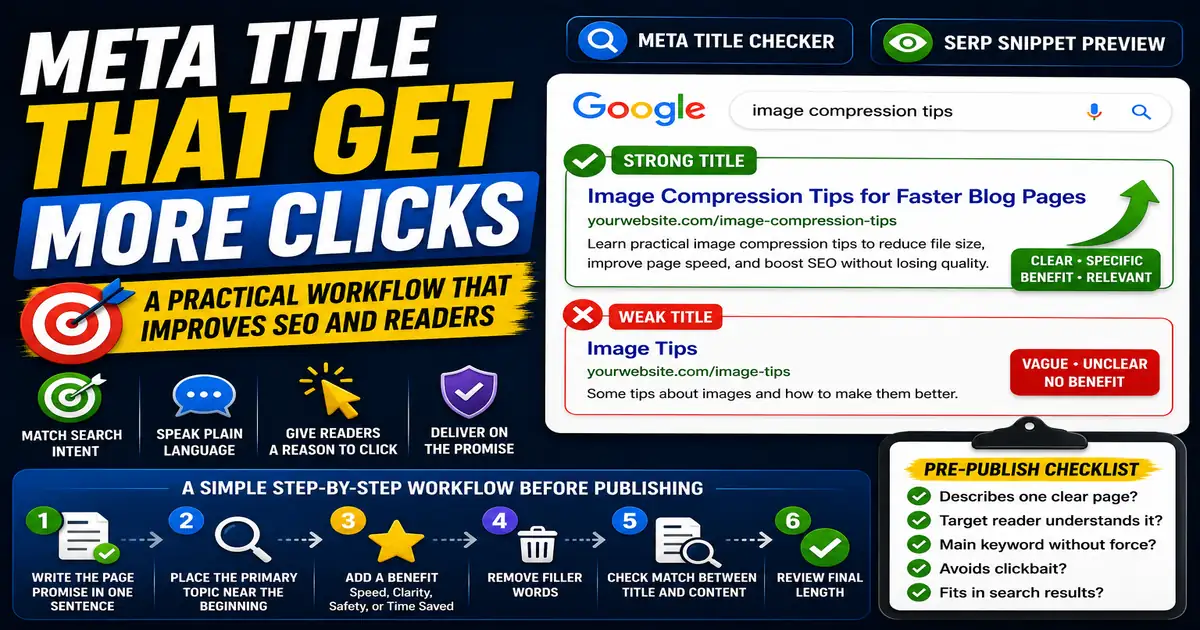
A meta title is often the first promise your page makes in search results. A better title does more than contain a keyword: it tells the right reader that the page solves the exact problem they have. This matters for bloggers, small business owners, and editors who publish content regularly because small publishing decisions compound across a site over time.
The Core Idea
The core idea is simple: strong titles balance search intent, plain language, and a reason to click without exaggerating the page content. When this idea is applied consistently, the page feels more intentional and the publishing process becomes less dependent on memory or guesswork.
Why It Matters in Practice
Imagine a guide about compressing images. A vague title such as Image Tips gives searchers little context, while Image Compression Tips for Faster Blog Pages describes the topic, the outcome, and the audience in a single line.
This is where local tools are useful. They give you a fast way to check one detail without opening a large application or sending your content through an external service. For a focused hands-on check, use the Meta Title Checker and SERP Snippet Preview while reviewing the page.
A Practical Step-by-Step Workflow
Before publishing a page, treat the title as a compact editorial decision rather than a place to stuff every possible phrase.
- Write the page promise in one plain sentence.
- Place the primary topic near the beginning when it reads naturally.
- Add a benefit such as speed, clarity, safety, or time saved.
- Remove filler words that do not change meaning.
- Check whether the title still matches the content after edits.
- Review the final length before publishing.
This workflow can be added to a publishing checklist, a content brief, or a personal editing routine. The exact order may change from one project to another, but the habit of checking before publishing is what protects quality over time.
Practical Example
For example, a post about image compression should not use a title that only says Image Tips. A stronger title names the task and the reader benefit, then the meta description can add supporting detail rather than repeating the same phrase.
Common Mistakes to Avoid
When optimizing this element in your drafts, review the final output carefully to avoid errors that compromise readability and search presentation. Watch for these specific mistakes:
- Repeating the same keyword twice.
- Using a clever headline that hides the actual topic.
- Promising results the article does not deliver.
- Forgetting the brand or page context when it matters.
- Writing every title from the same template.
Pre-Publish Checklist
Review this focused checklist before publishing your work to ensure all details are correct:
- Verify the title is under 60 characters and 600 pixels.
- Ensure your target keyword is front-loaded near the start.
- Add your brand name at the end separated by a dash or pipe.
- Check for truncation risk using a visual SERP preview.
A Small Workflow Tip
Keep a small swipe file of titles that actually earned clicks for your own site. Do not copy them blindly; study the pattern. Notice whether the winning titles were clearer, more specific, shorter, or better aligned with the searcher problem. When you write a new meta title, compare it with two or three of those examples and ask whether it makes the same kind of clear promise.