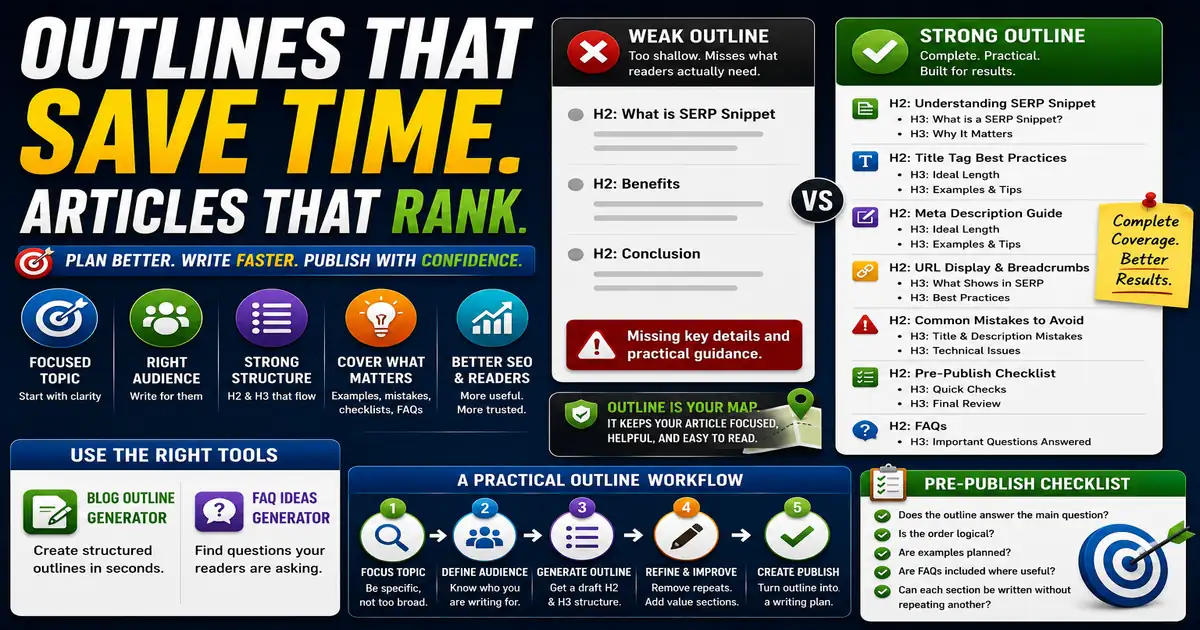
A strong outline saves writing time because it defines the article journey before the draft begins. It shows what the reader needs first, what proof or examples follow, and what questions should be answered before the ending. This matters for bloggers, content strategists, and solo site owners planning articles because small publishing decisions compound across a site over time.
The Core Idea
The core idea is simple: outline generation works best when templates are guided by a specific topic, audience, and search intent. When this idea is applied consistently, the page feels more intentional and the publishing process becomes less dependent on memory or guesswork.
Why It Matters in Practice
For a topic like SERP snippet preview, a weak outline might list only definition, benefits, and conclusion. A better outline includes title length, description examples, URL display, warnings, and a pre-publish checklist.
This is where local tools are useful. They give you a fast way to check one detail without opening a large application or sending your content through an external service. For a focused hands-on check, use the Blog Outline Generator and FAQ Ideas Generator while reviewing the page.
A Practical Step-by-Step Workflow
Use generated outline ideas as a starting map, then edit them based on what your readers actually need.
- Enter a focused topic rather than a broad industry phrase.
- Choose the reader type you are writing for.
- Generate a draft H2 and H3 structure.
- Remove sections that repeat each other.
- Add examples, mistakes, and checklist sections.
- Turn the final outline into a writing brief.
This workflow can be added to a publishing checklist, a content brief, or a personal editing routine. The exact order may change from one project to another, but the habit of checking before publishing is what protects quality over time.
Practical Example
An outline for a heading structure article should include what H1, H2, and H3 tags mean, how to audit them, and what mistakes to fix before publishing.
Common Mistakes to Avoid
When optimizing this element in your drafts, review the final output carefully to avoid errors that compromise readability and search presentation. Watch for these specific mistakes:
- Accepting an outline without editing it.
- Starting with a topic that is too broad.
- Forgetting examples and practical steps.
- Creating too many sections for a simple answer.
- Ignoring the reader knowledge level.
Pre-Publish Checklist
Review this focused checklist before publishing your work to ensure all details are correct:
- Map out headers (H2, H3) logically to cover sub-topics.
- Align outline sections with real user search questions.
- Ensure the flow moves from simple terms to details.
- Plan where to insert call-to-actions and internal links.
A Small Workflow Tip
Save outlines that produced strong articles. Over time, you will see which section patterns work for tutorials, comparisons, checklists, and beginner explainers. Reusing a proven structure is not the same as repeating content. The structure gives readers a familiar path while the examples and advice stay specific to the topic.